Products
SMTRY sells software a person or a firm owns outright. One product is live. The second is named and not yet described, by rule: a sentence about a product says what a buyer receives.
Anamnesis Live · free alpha
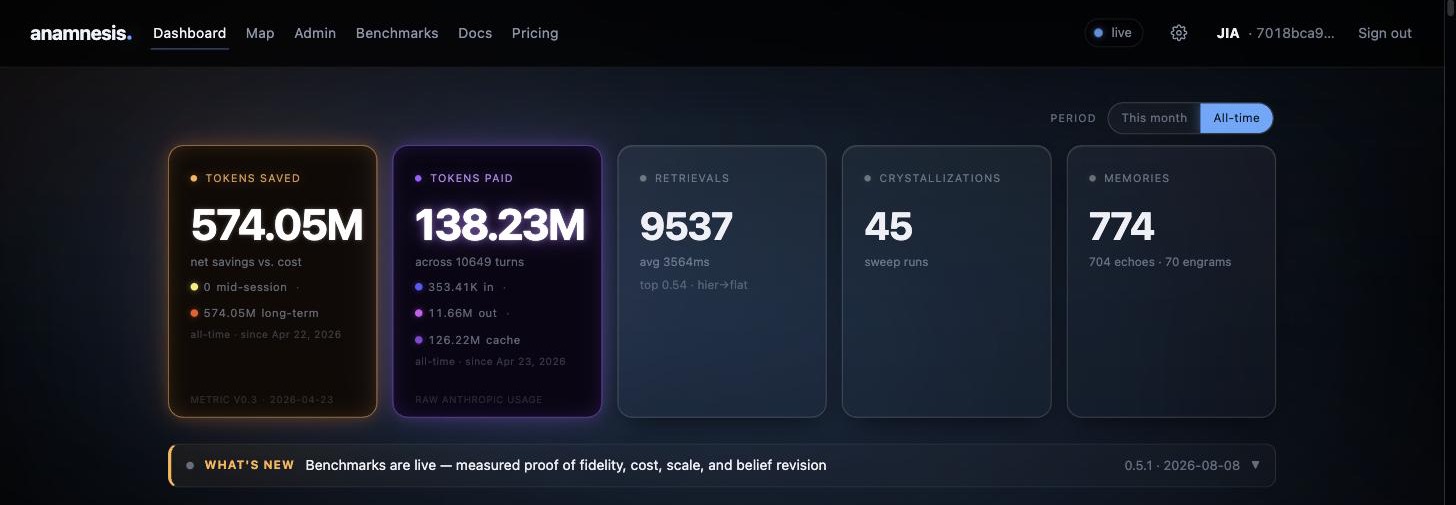
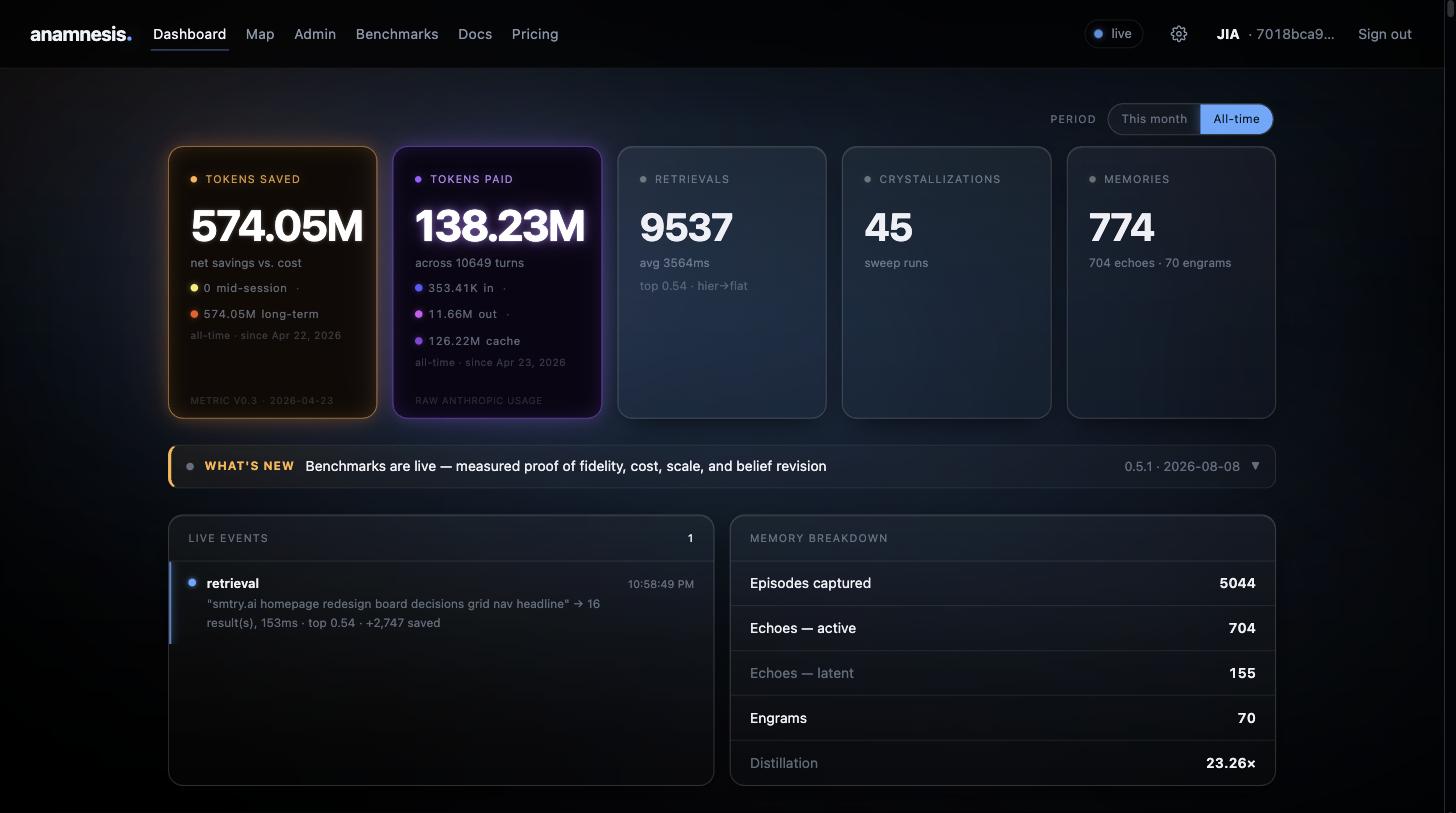
Say a thing once, in any of seven tools, and it is there in the others: Claude Code, Claude Desktop, claude.ai, Cowork, ChatGPT, Codex CLI, Gemini CLI. Each account holds its own keys; there is no master key. Export is plain JSON, anytime. Warm recall takes 0.2 to 0.4 seconds.
Architecture
One memory layer, seven clients on top of it, your keys underneath. Anamnesis is the product; the plugin sits in Claude Code, Claude Desktop, claude.ai, Cowork, ChatGPT, Codex CLI, and Gemini CLI, and all seven read the same store. What you tell one tool is available in the others. Below the store: per-account encryption, a screening step before a model's output is trusted, and the operating evidence we collect weekly. If it's drawn, it runs, with one exception: Atria, which is marked as in development.
Sources. Tulving, E. (1972), "Episodic and semantic memory," in Organization of Memory · Müller, G. E. and Pilzecker, A. (1900), Experimentelle Beiträge zur Lehre vom Gedächtnis · Semon, R. (1904), Die Mneme · Tonegawa lab, MIT, engram-cell studies. The measured figures on this site link to the product's benchmarks page. What is drawn is what the stages are; the thresholds and rules that decide what consolidates and what is trusted are not, by design.
Retrieval
Memories are stored in a temporal knowledge graph. Every entry keeps its time and its links to what was said with it. Retrieval starts from the prompt in front of you, which is the cue; the graph is read by that cue, and what comes back is what's connected to it. Warm, that read takes 0.2 to 0.4 seconds. Over time, memories are distilled; a distilled memory carries up to 27 times its stored size.
Atria In development
Accountability
Atria is in development. It's the second product, and we're not describing it until there's a measurement to describe. The rule on this site is that a sentence about a product says what a buyer receives. For Atria we can't say that yet, so the entry stays short. When it can, it'll carry numbers the way Anamnesis does.
Your account holds its own keys. You can see every memory, search all of it, and delete any of it. Each recall leaves a receipt in the prompt, so you know when memory was used and how much: "[anamnesis] recalled 3 memories for this prompt — context you didn't have to re-explain." SOC 2 isn't done; weekly operating evidence has been committed since August 2026, and the audit starts when it's funded. The firm is accountable, at hello@smtry.ai.
Need it inside your own systems? SMTRY Applied → · Questions first? Write to us →
 SMTRY
SMTRY