Anamnesis Live · free alpha
Say a thing once and it is there in the other tools. Encrypted with a key derived from your own credential, with no master key. Free while it is in alpha.
In practice
In the terminal tools, what you say while working is captured as you work. In the chat apps, the assistant saves what you ask it to keep. Either way it comes back where the next job is.
Measured
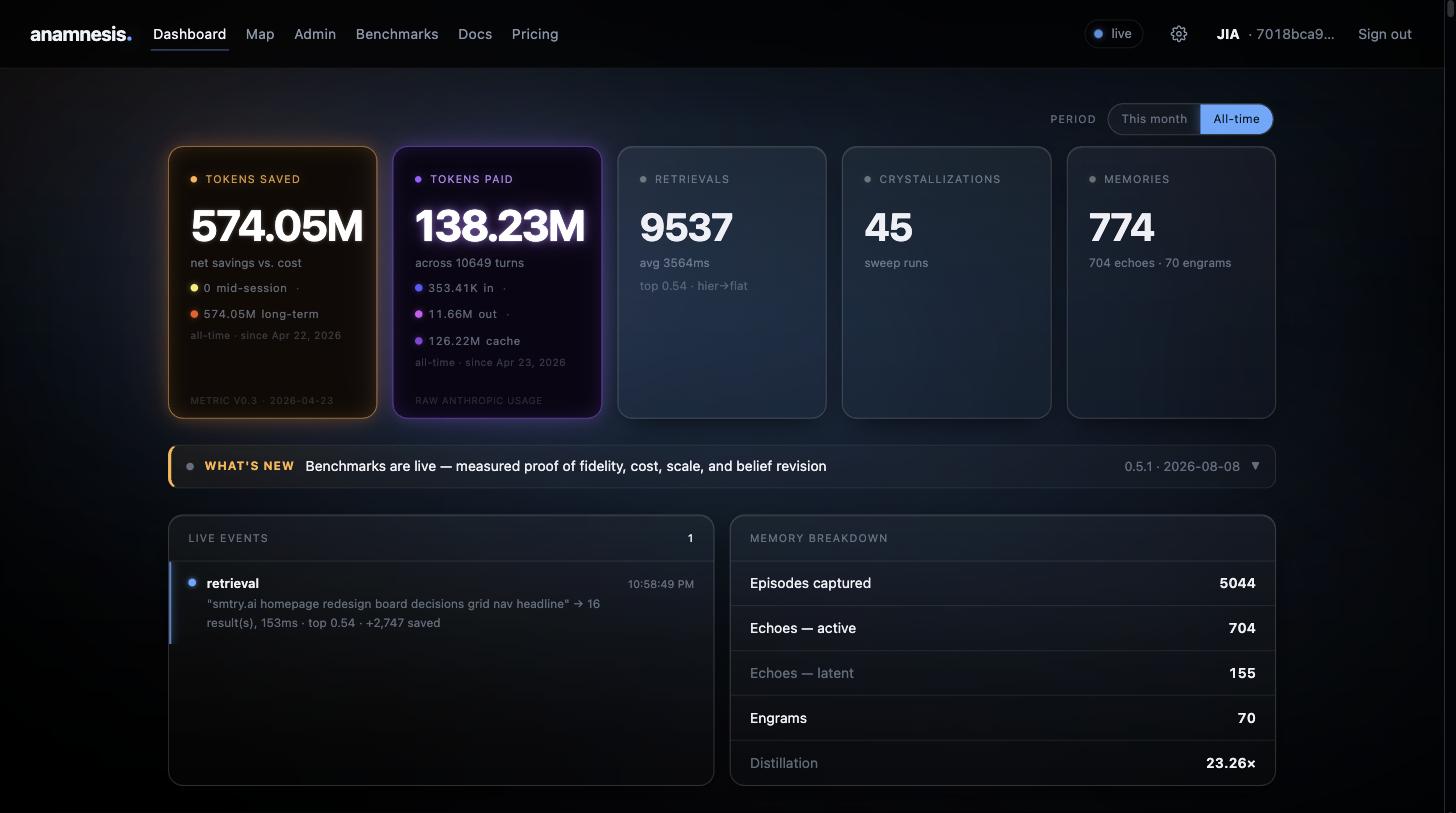
Retrieval, 13 to 42 milliseconds across the scale benchmark, flat through 1,000 records. The benchmark →
Fewer tokens than pasting the source. Injected memory reached 94.2% of the oracle answer quality at about one eighteenth of the tokens. How it's measured →
Tools, one connector. One account, one memory, read by every assistant you already open. The architecture →
How it works
One conversation with a connected tool. In Claude Code, Codex CLI and Gemini CLI it is captured turn by turn as it happens; in the chat apps the assistant relays what was said. No screening has happened yet. The raw material is what was said, with the context it was said in.
Each capture is stamped with its time, its tool, and who said it. “Keep it under two pages.” “Second person, present tense.” “The setup script takes four minutes.” In the terminal tools the turns arrive as written; in the chat apps they arrive as the assistant relays them. The falling matter is the conversation; the gas is its context.
One thing the session was about: a decision made, a problem solved, a preference stated. A session is cut into episodes, each with a beginning, an end, and a centre of its own.
An episode is read with what is already known in view, and what it meant is written down. In the science's words, elaborative encoding: new information tied to the structures already there. Gravity pulls the matter into a disc; the disc ignites.
A memory. The meaning of an episode, distilled. Four things orbit it: what was said, where it was said, when, and what kind of thing it is: a decision, an insight, a reference, a preference. The small moons are the details it keeps hold of: a path, a quoted line, a name.
Echoes that keep agreeing, across sessions and across tools, consolidate into something durable: memory consolidation, in the science's words. When a newer echo contradicts an older engram, the newer one, once confirmed, takes its place; the older one is not erased, it cools and moves aside. The star settles into a cluster; the one it supersedes reddens and drifts to the edge.
Long-term memory: what has been confirmed enough to be trusted. Engrams gather by meaning into convergence zones, so a task lands in a neighbourhood of knowledge rather than a flat list. The cluster is one such neighbourhood.
Once something is a memory, the system does not delete it. When it stops being confirmed it cools and goes quiet, and keeping it costs nothing. The star swells, reddens, and lets its layers go.
Still there, whole, waiting on a cue. The archive can grow without the cost of recall growing with it, because what is dormant is never loaded.
Recall triggered by a cue. It exists because loading everything would cost more with every memory kept; instead a new conversation's context is the cue, and only the memories that bear on it light up and are placed in front of the model. In the scale benchmark that read takes 13 to 42 milliseconds; the model's own reply time is separate. The cue reaches the gas; the gas falls back in.
Back, in a different tool on a different day. In the terminal tools it arrives with the prompt; in the chat apps the assistant asks for it at the start of a conversation. Memories that do not bear on the question are not loaded.
Architecture
One memory layer, seven clients on top of it, your keys underneath. If it is drawn, it runs.
Sources. Tulving, E. (1972), "Episodic and semantic memory," in Organization of Memory · Müller, G. E. and Pilzecker, A. (1900), Experimentelle Beiträge zur Lehre vom Gedächtnis · Semon, R. (1904), Die Mneme · Tonegawa lab, MIT, engram-cell studies. The measured figures on this site link to the product's benchmarks page. What is drawn is what the stages are; the thresholds and rules that decide what consolidates and what is trusted are not, by design.
Retrieval
Every memory keeps its time, its source, and a link to whatever superseded it. Retrieval starts from the prompt in front of you, which is the cue: the memories most relevant to it, ranked by relevance, recency and trust, come back, and superseded ones are held back. In the scale benchmark that read takes 13 to 42 milliseconds, flat through 1,000 records. Over time, memories are distilled; in the fidelity benchmark, injected memory used about one eighteenth of the tokens of pasting the source at 94.2% of the oracle answer quality.
Yours
Each account's memory is encrypted with a key derived from its own credential; there is no master key. Export is plain JSON, anytime. It is in alpha: it runs and it is still changing.
Security and evidence
Each account's memory is encrypted with a key derived from its own credential. Every memory is visible to you, searchable, and deletable. Captured content is screened before it becomes memory. We are not SOC 2 audited. Weekly operating evidence has been collected and committed since 20 August 2026; the audit starts when it is funded.
One account, seven tools, your own keys. No card.
 SMTRY
SMTRY